

In This Article
Every wheelchair transfer has a moment of truth. It’s the half-second when a pair of footrests either swings politely out of the way or sticks out like a coffee table in a narrow hallway. Get it wrong, and a simple move from chair to bed turns into a balancing act nobody signed up for.

That’s why a wheelchair for seniors with swing away footrests deserves more attention than it usually gets. Falls are a leading cause of injury for older adults, according to the CDC’s data on older adult falls, and transfers are one of the moments when they happen. Footrests that move aside are a small piece of hardware doing a surprisingly big safety job.
What Is a Wheelchair for Seniors with Swing Away Footrests?
A wheelchair for seniors with swing away footrests is a manual chair whose leg supports pivot sideways, or detach, so the front of the seat is completely open. That clear space lets an older adult stand, pivot, or slide across to a bed, toilet, or car seat without stepping over or around metal. Most also fold flat for storage.
This guide compares seven real models, explains seat depth, footplate angle, and leg rest hangers in plain English, and shows how to match a chair to an actual life. Reviews are summarized from real listings, and prices are shown as ranges because they move constantly.
Quick Comparison: 7 Wheelchairs with Swing Away Footrests
| Product | Best For | Seat Sizes (Verified) | Price Range |
|---|---|---|---|
| Medline Swing-Back Desk Arm Wheelchair | All-round home use | 16″, 18″, 20″ wide x 16″ deep | $160-$200 |
| Drive Medical Blue Streak | Tight budgets | 18″ and 20″ wide | $130-$180 |
| Drive Medical Silver Sport 2 | Full-arm support | 18″ wide | $150-$200 |
| Drive Medical Cruiser X4 | Adjustability | 16″ and 20″ wide | $270-$330 |
| Medline Guardian K1 | Choice of leg rest style | 16″ and 18″ wide x 16″ deep | $280-$330 |
| Carex Aluminum Wheelchair | Lighter aluminum frame | Check listing | $140-$180 |
| Medline Excel Extra-Wide | Larger frames, bariatric needs | 22″ and 24″ wide | Mid-$300s and up |
Looking at the table, the Drive Medical Blue Streak and Medline Swing-Back Desk Arm Wheelchair cover most households at the lowest cost. The Drive Medical Cruiser X4 and Medline Guardian K1 cost roughly $100 more, and that premium buys adjustability and configuration choices rather than basic function. The Medline Excel Extra-Wide is in its own category because it solves a sizing problem the others don’t.
💬 Just one click — help others make better buying decisions too!😊
Top 7 Wheelchairs for Seniors with Swing Away Footrests: Expert Analysis
Each pick below pairs the spec sheet with what it means in daily use. Check the current listing for exact configurations before you order.
1. Medline Wheelchair with Swing-Back Desk Arms and Swing-Away Footrests — best everyday all-rounder
The headline trick here is that the arms and the footrests both get out of your way.
The seat is offered in 16″, 18″, and 20″ widths, all with a 16″ depth, and the weight capacity is 300 lb. Swing-back, desk-length arms mean you can roll up to a table, then clear the side for a lateral transfer. Paired with leg rests that swing away, the whole front and side of the chair opens up.
Based on the spec comparison, this suits seniors who still transfer with a little help and want one chair for the dining table, the living room, and the car trunk. The fixed 16″ depth is the thing to check: it’s comfortable for average thigh length, but very tall or very petite users should measure first.
Reviewers on retailer listings rate it around 4.5 stars across several hundred ratings. One volunteer in a care home called it a standout affordable option. One buyer reported a footrest clip that arrived slightly bent and wouldn’t latch until it was fixed, so test the latches the day it arrives.
Pros:
- ✅ Swing-back arms and footrests open both sides
- ✅ Three seat widths in one model line
- ✅ 300 lb capacity at a modest price
Cons:
- ❌ Fixed 16″ seat depth won’t suit everyone
- ❌ Occasional latch fit-and-finish complaints
Price runs around the $160-$200 range, which is strong value for a chair with this much transfer flexibility.

2. Drive Medical Blue Streak — best budget-friendly transfer chair
The Drive Medical Blue Streak wins on price without dropping the features that matter.
It pairs a steel frame with flip-back desk arms, swing-away footrests, and calf straps, offered in 18″ and 20″ seats. Flip-back arms let you slide sideways onto a bed edge, and the calf straps keep lower legs from drifting backward when the chair rolls over a threshold. Steel is heavier than aluminum, so expect more to lift into a trunk.
On paper this is the best fit for a household that needs a second chair for appointments or short-term recovery. Another point in its favor: Drive’s swing-away footrests are listed as compatible across several of its chairs, including the Silver Sport and Cruiser lines. That’s a quiet advantage if a footplate cracks in year three.
At one major retailer the chair averaged roughly 4.3 stars, though on a smaller review pool, so treat that as a directional signal rather than proof.
Pros:
- ✅ Lowest cost of the seven picks
- ✅ Calf straps included for leg stability
- ✅ Footrest parts shared across Drive models
Cons:
- ❌ Steel frame is heavier to lift
- ❌ Smaller review sample at the listing checked
Expect to pay in the $130-$180 range. It’s the budget winner if your needs are straightforward.
3. Drive Medical Silver Sport 2 — best for full-arm support
If standing up depends on pushing off a solid armrest, full arms matter more than desk length.
The Drive Medical Silver Sport 2 has detachable full-length arms and swing-away footrests, listed here in an 18″ seat. Full arms give a long, stable surface to lean on when rising, and because they detach, you can still clear the side when someone needs to slide across.
What the spec sheet won’t tell you is how long the armrest lets you wait before committing to the stand. For seniors with shaky quads, that extra second of support is the product. Compared with desk-length designs, though, full arms keep you farther from a table, so dining-room use is less convenient.
The review pool I could verify was tiny, just a handful of ratings at one retailer, so I’m not drawing conclusions from it. Check the current listing for a larger sample.
Pros:
- ✅ Long arms give steady push-off support
- ✅ Detachable arms clear the transfer side
- ✅ Compatible Drive footrest parts available
Cons:
- ❌ Full arms sit farther from tables
- ❌ Limited verified review data
The price falls in roughly the $150-$200 range, good value for the support it gives.
4. Drive Medical Cruiser X4 — best for fine-tuned adjustability
Think of this one as the chair you adjust, not the chair you adapt to.
The Drive Medical Cruiser X4 is a lightweight dual-axle model with adjustable detachable arms, desk arms, and swing-away footrests, listed in 16″ and 20″ seat widths. A dual-axle design lets the seat height shift, which can mean the difference between a hip-friendly transfer and a hard drop onto a low couch.
My read of the spec comparison: this fits a family sharing one chair between two users of different heights, or a senior whose needs will change as recovery progresses. It costs about double the entry-level models, so the question is whether you will actually use the adjustments.
I couldn’t verify a meaningful independent review set for this model, so I’m not summarizing sentiment I can’t source.
Pros:
- ✅ Dual-axle design allows seat-height changes
- ✅ Adjustable detachable arms for varied transfers
- ✅ Lightweight build helps with car loading
Cons:
- ❌ Roughly double the price of basic chairs
- ❌ Few verifiable reviews to lean on
Pricing sits in the $270-$330 range. It’s worth it only if you’ll use the adjustability.
5. Medline Guardian K1 — best for choosing your leg rest style
Here you decide between swing-away footrests and elevating leg rests before you buy.
The Medline Guardian K1 is a K1-class chair with a 300 lb capacity, 8″ front casters, and 24″ rear wheels. The 18″ x 16″ size comes with removable desk-length arms or full-length removable arms, and both swing-away and elevating versions are offered. Larger rear wheels make self-propelling easier on carpet; the 8″ casters handle small thresholds.
The practical take: if there’s any chance of swelling or circulation issues that call for propping the legs, choose the elevating version from the start rather than retrofitting. If transfers are the priority, the swing-away version is cleaner.
I couldn’t verify an aggregated rating, so check the current listing for fresh customer feedback.
Pros:
- ✅ Swing-away or elevating leg rest choice
- ✅ Desk-length or full-length arm options
- ✅ Larger rear wheels for self-propelling
Cons:
- ❌ Pricier than comparable Medline basics
- ❌ Variant naming confuses first-time buyers
Expect roughly the $280-$330 range. It’s a fair price if the configuration choice matters.

6. Carex Aluminum Wheelchair — best lighter-frame alternative
Aluminum means less to heave into the trunk, and that alone can decide whether a family actually uses the chair.
The Carex Aluminum Wheelchair pairs swing-away footrests with removable armrests, a padded seat, and a 300 lb capacity. Removable armrests are a plus for side transfers, and the padded seat helps with longer sitting sessions. Aluminum is typically lighter than steel, which matters most for a caregiver who lifts the chair alone.
It’s a strong fit for a caregiver with a bad back or a senior who travels often. The tradeoff is that I couldn’t confirm seat dimensions from the sources checked, so measure against the listing before buying.
At one retailer it averaged about 4.3 stars across roughly 44 reviews, a modest but reasonable sample.
Pros:
- ✅ Lighter aluminum frame for easy lifting
- ✅ Removable armrests ease side transfers
- ✅ Padded seat adds sitting comfort
Cons:
- ❌ Seat dimensions need checking per listing
- ❌ Smaller review pool than the bigger brands
Pricing is generally in the $140-$180 range, a decent middle path between steel basics and premium chairs.
7. Medline Excel Extra-Wide — best for larger frames and bariatric needs
Most wheelchair guides treat a 24-inch seat as an afterthought. This one makes it the point.
The Medline Excel Extra-Wide comes in a 24″ seat width rated for up to 500 lb, with swing-away footrests that pivot aside for easier entry and exit. A 22″ version with removable desk-length arms also appears in listings. The wider frame means you’ll want to check door widths at home before ordering.
This is the right pick when a standard 18″-20″ chair pinches the hips or presses the thighs against the armrests. Ill-fitting chairs create pressure points, and swing-away footrests are even more important when the frame is wide and transfers are tighter.
The 22-inch sibling averaged about 4 stars across roughly 110 reviews at one retailer, which is decent but not glowing.
Pros:
- ✅ 24″ width and 500 lb capacity
- ✅ Swing-away footrests simplify wide transfers
- ✅ 22″ option with desk-length arms
Cons:
- ❌ Wider frame can limit doorway access
- ❌ Costs more than standard-width chairs
Pricing starts in the mid-$300s and climbs with size, so check the current price for your width.
How the Seven Compare on Specs
| Product | Arms | Capacity | Footrest Options |
|---|---|---|---|
| Medline Swing-Back Desk Arm Wheelchair | Swing-back desk-length | 300 lb | Swing-away |
| Drive Medical Blue Streak | Flip-back desk-length | Verify per size | Swing-away with calf straps |
| Drive Medical Silver Sport 2 | Detachable full-length | Verify per size | Swing-away |
| Drive Medical Cruiser X4 | Adjustable detachable desk | Verify per size | Swing-away |
| Medline Guardian K1 | Removable desk or full-length | 300 lb | Swing-away or elevating |
| Carex Aluminum Wheelchair | Removable | 300 lb | Swing-away |
| Medline Excel Extra-Wide | Removable desk-length (22″) | Up to 500 lb (24″) | Swing-away |
Read the table with one thing in mind: where it says “verify per size,” the listing didn’t state a capacity clearly in the sources I reviewed. The Medline Excel Extra-Wide is the clear outlier on capacity, while the Medline Guardian K1 is the only one explicitly offering elevating leg rests as an alternative.
✨ Don’t Miss These Exclusive Deals!
🔍 Ready to shop? Click any highlighted product name above to check current pricing and availability. A well-matched chair makes every transfer safer for the person sitting in it and the person helping them!
Swing Away Leg Rests Wheelchair for Easy Transfers: A Step-by-Step Guide
Owning the right hardware is half the job. The other half is using it in the right order. Here is a sequence that works with any chair on this list:
- Position the chair. Place it at a slight angle to the bed, toilet, or car seat, close enough to cut the reach.
- Lock the brakes. Federal safety guidance for long-term care lists locking the wheelchair before a transfer as a basic step (AHRQ falls management resources).
- Swing both footrests out. Pivot them fully to the side, not just halfway. A half-open footplate is still a toe-stubber.
- Move the armrest if yours moves. Swing-back or flip-back arms clear the transfer side.
- Scoot forward, plant both feet, and pivot. Keep the movement smooth rather than sudden.
- Reverse the steps. Return the footrests before anyone sits back down and rolls away.
A fun fact about those six steps: nobody remembers step six. People finish the transfer, relax, and then wheel off with the footrests still swung wide. Make a habit of looking down before moving.

Real-World Scenarios: Matching a Chair to a Life
Specs are abstract. Lives are specific. Here are three realistic profiles and the picks that fit them.
The post-surgery grandparent. Recovering from a hip procedure for a few months, mostly at home, with a family member helping. The Medline Swing-Back Desk Arm Wheelchair works well here: it’s affordable, rolls up to the dining table, and the swing-back arms plus swing-away footrests make bed-edge transfers simple. The price won’t sting if the chair is only needed short term.
The traveling caregiver. A daughter who drives her father to appointments weekly and lifts the chair into an SUV alone. The Carex Aluminum Wheelchair deserves a hard look because lighter aluminum reduces strain over hundreds of lifts. Ask about seat dimensions before ordering.
The senior who needs full-arm leverage. Someone with weak legs who pushes up from armrests and refuses to be rushed. The Drive Medical Silver Sport 2 gives long, stable arms that can still detach for lateral moves.
The principle across all three is the same: start with who is transferring, where, and how often. Then pick the chair, not the other way around.
Problem → Solution: Fixing Common Footrest Headaches
Footrest trouble tends to show up in the first month. Here’s how to handle the usual suspects.
- A footrest won’t latch. Press the clip firmly and inspect it for bending. One reviewer found a slightly bent clip on a new chair, and the manufacturer sent a replacement. Don’t ride with a footrest that doesn’t click into place.
- Toes drag or heels slip off. This usually points to footplate height or angle. See the footplate angle section below.
- Knees sit too high. A footplate that’s too high pushes the knees above a comfortable 90 degrees and creates pressure points (1-800-Wheelchair fit guide). Lower it a notch.
- The chair feels longer than the listing says. Swing-away assemblies typically add to the frame depth, so the real footprint is bigger than the seat-depth number.
- Replacement parts are hard to find. Stay inside one brand family. Drive lists the same swing-away footrests as compatible across its Blue Streak, Silver Sport, and Cruiser lines.
Detachable Footrest Wheelchair for Elderly Users: Swing-Away vs. Fixed vs. Elevating
A detachable footrest wheelchair for elderly users solves a different problem than a fixed one. Detachable and swing-away designs trade a little rigidity for a lot of access.
| Feature | Swing-Away / Detachable | Fixed Footrests | Elevating Leg Rests |
|---|---|---|---|
| Transfer access | Excellent, front fully open | Poor, must step over | Moderate |
| Folding and storage | Easier, parts come off | Bulkier | Bulkier |
| Leg elevation | No | No | Yes |
| Best for | Frequent transfers | Long-distance self-propellers | Swelling or circulation issues |
The table makes the tradeoff plain. Swing-away footrests win on access and storage, while elevating leg rests win only when the legs need propping. For most seniors who transfer several times a day, detachable designs are the practical default. Reserve elevating rests for people whose doctor has advised raising their legs, which is why the Medline Guardian K1 offers both versions.
One caveat: detachable parts can get lost. Keep a pair of spare footrests or a labeled bag, because a chair missing a footrest is a chair someone shouldn’t use.
How to Choose a Wheelchair for Seniors with Swing Away Footrests
Pick a chair using these six steps, in this order:
- Measure the person first. Seat width, seat depth, and lower-leg length come before any shopping.
- Decide who is transferring and how. Independent transfers favor full arms; assisted ones favor swing-back or flip-back desk arms.
- Match the capacity with margin. Pick a rated capacity comfortably above current weight.
- Check footrest hardware. Look at the latch, the footplate material, and whether replacements are widely available.
- Weigh the chair against its job. If a caregiver lifts it into a car, weight matters as much as comfort.
- Confirm the doorways. A chair that doesn’t fit through the bathroom door isn’t a solution.
Seat Depth: The Measurement That Decides Comfort
Seat depth is the quiet dimension that makes or breaks a long afternoon in a chair.
To measure it, sit upright and measure from the back of the buttocks to the back of the knee. A well-fitted seat leaves about two to three finger-widths between the front edge and the back of the knee (1-800-Wheelchair). Too deep, and the pelvis slides forward into a slouch while the seat edge presses behind the knee. Too shallow, and the thighs hang unsupported.
Here is where our picks land. The Medline Swing-Back Desk Arm Wheelchair and Medline Guardian K1 both list a 16″ depth. That fits many adults, but not everyone. For a taller senior with long thighs, 16″ can feel short; for a very petite user, it can feel deep.
Also remember that the listed seat depth is not the chair’s footprint. As a clinical guide notes, adding a swing-away leg rest assembly usually increases seat frame depth, so a listed number from one chair can’t simply be transferred to another without re-measuring (NSW Agency for Clinical Innovation). In short: measure the body, then check the spec.
Footplate Angle: Small Tilt, Big Comfort
Footplate angle sounds like a niche concern until your ankles start complaining.
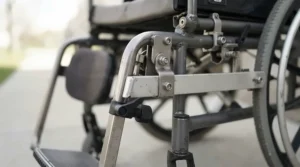
It’s the tilt of the footplate relative to the leg rest tube. Set it well, and the foot rests flat and secure. Set it poorly, and feet slide forward or toes curl. For people with stiff or contracted ankles, the guidance from clinical seating resources is to use a smaller frame angle so the feet don’t slide off the plate.
Three practical checks apply. First, look for at least about two inches of clearance between the footplate and the floor, so it doesn’t catch on thresholds. Second, make sure the knees sit near a comfortable 90 degrees rather than being pushed upward. Third, if the footplates are adjustable, change them one notch at a time and test for a day.
None of the budget picks here advertise fine-grained footplate angle adjustment as a headline feature, so check each listing. If your feet don’t sit flat, that’s a signal to ask before buying, not after.
Leg Rest Hangers: The Overlooked Hardware
Leg rest hangers are the tubes and brackets that connect the footplate to the chair frame. They’re also where swing-away designs actually pivot.
The hanger’s angle affects how far the toes extend forward, and a tighter angle allows the chair to turn in less space. That matters in small bathrooms and narrow hallways. Longer or more forward-leaning hangers feel roomier for long legs but can bump into walls and furniture.
Quality indicators to look for include a firm, audible latch, no wobble when the footrest is locked, and metal that isn’t bent out of shape. Retailers also sell replacement pairs of swing-away footrests separately, and some specialty parts for Medline lines start around $10 to $25, so a damaged hanger rarely requires a whole new chair. Stick to parts rated for your exact model.
Common Mistakes When Buying a Wheelchair for Seniors with Swing Away Footrests
Most regrets come from a short list of avoidable errors.
- Buying on seat width alone. Seat depth, footrest length, and arm style matter just as much.
- Ignoring the caregiver’s body. A heavy steel frame that hurts the lifter will end up in the garage.
- Choosing a hand-me-down. A researcher at the University of Illinois points out that many falls trace back to chairs that weren’t fitted to the person, often secondhand, and to a lack of transfer training (University of Illinois).
- Skipping the latch test. Check the footrest locking action before the return window closes.
- Forgetting about the cushion. A cushion adds seating height, which changes footplate clearance and knee angle.
- Treating elevating rests as an upgrade. They aren’t, unless circulation or swelling demands them.
Long-Term Cost & Maintenance
A $150 chair can become a $300 chair if you’re not paying attention to upkeep.
| Cost Area | What to Expect | Why It Matters |
|---|---|---|
| Purchase | $130-$450 range across these picks | Upfront cost sets expectations |
| Footrest parts | Often roughly $10-$100 per pair | Cheaper than replacing the chair |
| Cushion upgrade | Optional, varies | Improves comfort and fit |
| Tire and caster wear | Occasional | Affects rolling smoothness |
The takeaway: spending more doesn’t automatically cut long-term cost. What does is choosing a model with widely available parts, like the Drive Medical Blue Streak, and keeping to a simple maintenance routine. Monthly, check the brakes, the footrest latches, the tire condition, and every bolt and fastener. Quarterly, wipe down the frame and inspect the upholstery.
Wheelchair Safety Guide for Seniors
Safety isn’t glamorous, but it’s the whole reason to buy swing-away footrests.
About half of wheelchair users report musculoskeletal pain, mostly in the shoulders, and older users are more likely than younger ones to be seriously hurt by tipping or falling (Medical News Today). Missing parts, broken parts, and incorrect fit all show up as equipment-related fall risk factors in long-term care guidance.
Some simple habits cut that risk:
- Lock the brakes before every transfer.
- Keep seating items, such as the cushion, in the chair.
- Replace any broken or missing footrest right away.
- Wear closed, grippy shoes during transfers.
- Ask a physical or occupational therapist to watch a transfer or two.
Treat that last point as a bargain. A single therapy visit can show you a technique that prevents a fall.
FAQ
❓ Can swing away footrests be added to a wheelchair that didn't come with them?
❓ How tall should the footplate sit above the floor?
❓ What seat width do most seniors need?
❓ Does Medicare cover a wheelchair with swing away footrests?
❓ How do I know if a footrest latch is secure?
Conclusion
A wheelchair for seniors with swing away footrests isn’t a luxury feature. It’s the difference between a transfer that feels routine and one that feels like a gamble.
If you want a single recommendation from the research, start with the Medline Swing-Back Desk Arm Wheelchair: strong all-round value and open access on both sides. For tight budgets, the Drive Medical Blue Streak keeps the essentials. If you need full-arm leverage, look at the Drive Medical Silver Sport 2. For adjustability, the Drive Medical Cruiser X4 earns its premium, while the Medline Guardian K1 lets you choose between swing-away and elevating rests. Lighter lifting points to the Carex Aluminum Wheelchair, and larger frames call for the Medline Excel Extra-Wide.
Whichever you pick, measure first, test the latches, and lock the brakes every time. The best chair is the one that fits the person sitting in it.
Recommended for You
- [Add your blog post link 1]
- [Add your blog post link 2]
- [Add your blog post link 3]
Disclaimer: This article contains affiliate links. As an Amazon Associate, I earn from qualifying purchases. If you purchase products through these links, we may earn a small commission at no additional cost to you.
✨ Found this helpful? Share it with your friends! 💬🤗
